Product Information
CosmySupplies supplies cosmetic grade Cocodiethanolamide (CDEA), also called Cocamide DEA (INCI: Cocamide DEA), in stock in India for immediate dispatch from Bengaluru. It is a non-ionic foam booster and viscosity builder derived from coconut oil fatty acids, used at 2 to 5 percent in rinse-off personal care formulations. Small and bulk order sizes are available. Order at cosmysupplies.com.
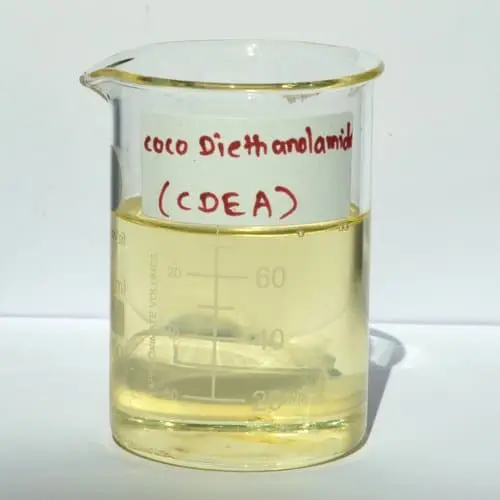
INCI: Cocamide DEA | Also listed as: Cocodiethanolamide | Origin: Vegetable derived | Grade: Cosmetic | Form: Light yellow transparent liquid
Functions: Foam Boosting | Viscosity Building | Surfactant | Emulsifying | Hair Conditioning | Skin Conditioning
Used In: Shampoo | Body Wash | Liquid Hand Soap | Bubble Bath | Shaving Cream | Facial Cleanser | Household Cleaner
Rinse-Off | Foam Booster | Viscosity Builder | Coconut Derived | Cost-Effective | SLES Compatible
Benefits
• Increases foam volume and stability in anionic surfactant systems, making SLES-based shampoos and body washes produce visibly richer, more sustained lather at a small addition level of 2 to 5 percent.
• Builds viscosity in aqueous surfactant systems without a separate polymer thickener, reducing formula complexity and ingredient count in a standard shampoo or body wash base.
• Improves the feel of the foam during and after application, giving surfactant systems a creamier, less watery texture that is associated with a higher quality product by consumers.
• Compatible with SLES, CAPB, and other anionic and amphoteric surfactants commonly used in shampoo, body wash, and hand soap formulations, making it a straightforward addition to existing bases.
• CIR Expert Panel assessed safe as used in rinse-off products, with a well-established safety profile across decades of global personal care use.
• Functions as both a foam stabiliser and an emulsifying agent, helping to disperse added oils, fragrances, or actives in a surfactant base without a separate solubiliser at low inclusion levels.
• Concentrated liquid format with near-neat active content, requiring small addition levels to achieve the target foam and viscosity effect, which reduces transport and storage cost per effective dose.
Applications
In a shampoo built on an SLES or SLES-CAPB base, CDEA is the most practical way to increase foam volume and thicken the product in one step. At 2 to 4 percent it builds viscosity and adds foam body without changing the cleansing profile. The shampoo feels more premium on wet hair and rinses cleanly.
In a body wash or shower gel, it stabilises the foam against body oils and sebum, maintaining lather quality throughout the wash cycle. This is its most valued function in body wash formats, where consumer perception of foam quality during the wash influences repeat purchase.
In a liquid hand soap, it builds the viscosity that makes the product dispense at the right consistency from a pump, and it stabilises the foam that forms on the hands during washing. At 2 to 3 percent it does both without requiring a separate salt or polymer thickener.
In a bubble bath, it increases the volume and longevity of the foam that forms in the bathwater, contributing to the sensory experience of the product without changing the cleansing character of the base.
In a shaving cream or gel, it thickens the product and stabilises the dense foam that provides the cushioning needed for a comfortable shave. It is water soluble and cold-processable, making it practical for shaving gel formulations that do not require a heat phase.
How to Use
For Shampoo, Body Wash, and Hand Soap
Add CDEA to the water phase or to the main surfactant blend at room temperature. It disperses readily in water and does not require heating. Start at 2 percent of the total formula and assess the viscosity and foam response before adjusting upward. In SLES-based systems, viscosity builds progressively with CDEA level. Most effective results are at 2 to 5 percent. Above 5 percent the incremental viscosity and foam gain diminishes and cost efficiency drops.
For Bubble Bath and Shaving Cream
Add to the water or surfactant phase and mix until incorporated. The foam stabilisation effect is apparent in use. Confirm the finished formula viscosity and foam profile in a trial batch before scaling, as other formula components will influence both.
pH adjustment
As supplied, CDEA has a pH of 9.00 to 11.0 in a 2% aqueous solution. Adjust the finished formula to the target skin pH using citric acid before adding heat-sensitive actives or fragrance.
Formulation restriction note
Do not combine CDEA with sodium lauryl sarcosinate (NaLS) or other sarcosinate surfactants, or with any ingredient that functions as a nitrosating agent, in the same formula. See Important Information below.
Claims You Can Make
For your label and marketing:
Coconut Derived | Rinse-Off | Foam Boosting | Viscosity Building | Rich Lather
For your formulator brief:
Foam Boosting Surfactant (INCI confirmed) | Viscosity Building Agent (INCI confirmed) | Hair and Skin Conditioning Agent (INCI confirmed) | Emulsifying Agent (INCI confirmed) | CIR safe as used in rinse-off, safe up to 10% in leave-on (CIR 1996, reaffirmed 2013) | Compatible with SLES, CAPB, and standard anionic/amphoteric surfactant systems | Must not be used with nitrosating agents in the same formula.
For formulation guidance, contact CosmySupplies directly.
WhatsApp | Email: info@cosmysupplies.com
Technical Information
|
Property |
Value |
|
INCI Name |
Cocamide DEA |
|
Trade / Catalogue Name |
Cocodiethanolamide (CDEA) |
|
Physical Form |
Light yellow transparent liquid |
|
Colour |
Light yellow |
|
Odour |
Minor characteristic odour |
|
Origin / Nature |
Vegetable derived |
|
CAS Number |
68603-42-9 |
|
EINECS |
271-657-0 |
|
pH (2% aqueous, 25°C) |
9.00 to 11.0 as supplied. Adjust finished formula to target skin pH using citric acid. |
|
Water Content |
1.00% maximum |
|
Acid Value |
2.00 mgKOH/g maximum |
|
Amine Value |
25 mgKOH/g maximum |
|
Recommended Usage Rate |
Rinse-off shampoo, body wash, hand soap: 2 to 5% of formula as supplied. Up to 10% in leave-on products. |
|
Charge |
Non-ionic |
|
Solubility |
Water soluble. Cold process compatible. Add to water or surfactant phase at room temperature. |
|
Compatibility |
SLES, CAPB, anionic and amphoteric surfactants. Must not be combined with nitrosating agents. |
|
Shelf Life |
2 years from manufacture date |
|
Storage |
Store at room temperature, sealed, away from light |
|
|
|
|
Bulk Enquiries |
Pairs Well With
SLES (Sodium Lauryl Ether Sulphate) is the primary cleansing base that CDEA is most commonly added to. CDEA at 2 to 4 percent in an SLES system measurably increases foam volume and builds viscosity. The ratio between SLES and CDEA sets the final viscosity and foam character of the shampoo or body wash.
Cocamidopropyl Betaine (CAPB) is the standard mild amphoteric in the SLES-CAPB-CDEA trinity that underlies most commercial shampoos globally. CAPB adds foam density and mildness; CDEA adds foam stability and viscosity. Together with SLES they form a complete, cost-effective, high-performance shampoo base.
PEG 150 Distearate is the catalogue alternative for viscosity building when a higher-viscosity or pearlescent finish is needed. In some shampoo systems CDEA and PEG 150 Distearate are used together, with CDEA providing the foam and PEG 150 Distearate providing the thickening and opacity.
Betaine Powder adds humectancy and skin feel improvement to a CDEA-containing cleanser base. At 1 to 2 percent it softens the after-rinse skin sensation without changing the foam profile.
Sodium Chloride (NaCl) can be used alongside CDEA to further adjust viscosity. CDEA builds viscosity independently, but in SLES-based systems the CDEA and salt thickening effects are additive. Confirm the viscosity response at your target salt level before scaling.
Euxyl PE 9010 provides broad spectrum preservation in any water based formula containing CDEA. Required in all rinse-off formulations with a water phase.
Important Information
Cocodiethanolamide (CDEA) is a rinse-off surfactant ingredient. Use in rinse-off personal care products such as shampoo, body wash, and hand soap. For leave-on applications, the CIR assessed it as safe at concentrations up to 10 percent.
Formulation restriction: CDEA must not be combined with ingredients that function as nitrosating agents in the same formula, including DEA-based surfactants used in excess, secondary amine-containing ingredients, or any ingredient whose safety depends on the absence of nitrosamines. This is a standard CIR-stated restriction for this ingredient class.
Regulatory context: the International Agency for Research on Cancer (IARC) classified Cocamide DEA as Group 2B, possibly carcinogenic to humans, in 2013, based on animal studies. This classification applies to the ingredient in isolation under occupational exposure conditions, not to rinse-off cosmetic use at 2 to 5 percent. The CIR Expert Panel, which evaluates cosmetic use specifically, concluded it is safe as used in rinse-off products. Formulators building products for the EU market should note the EU Cosmetics Regulation restricts Cocamide DEA to rinse-off products at a maximum of 10 percent and requires the secondary amine content to meet specified limits. Formulators building for other markets should confirm local regulations independently.
If you are looking for an alternative foam booster with a different regulatory profile, CMEA (Coco Monoethanolamine) is available from CosmySupplies and performs a similar function.
Disclaimer:
All products sold by CosmySupplies are supplied as raw materials for research, formulation, and manufacturing purposes. The information on this page is for formulation reference only and does not constitute professional, regulatory, or safety advice.
Raw materials of natural or botanical origin may show variation in colour, odour, texture, and physical properties between batches. These variations are inherent to the material and do not indicate a change in quality or function.
Customers are responsible for evaluating the suitability of any ingredient for their specific application and ensuring compliance with applicable regulations. CosmySupplies does not guarantee suitability for any specific end use without independent verification.
All transactions on CosmySupplies are B2B in nature. Contact us at support@cosmysupplies.com or WhatsApp before placing a bulk order. cosmysupplies.com.
Our latest content
Check out what's new in our company !